Introduction. Grammar is an essential part of the language learning process, as it provides the structural basis for meaningful conversation. In the case of L2 learning, grammatical accuracy is important for the production of coherent and meaningful utterances (Alzahrani, 2024: 1174). Whereas grammatical knowledge is required for the production of syntactically correct sentences and hence avoids misunderstandings and increases the speed of communication (Alzahrani, 2024).
Of the many grammatical features of the Russian language, its six cases − nominative, accusative, genitive, dative, instrumental and prepositional − are among the most challenging for learners of the language. Ceytlin, S.N., Kruglyakova, T.A. (Ceytlin, Kruglyakova, 2024) claim that these cases mark nouns, pronouns, and adjectives, and the forms of these changes according to the syntactic role that they play in a given sentence. Russian, unlike English, achieves this by means of case endings, that is, by marking relationships between words. Due to the morpho-syntactic complexity, the mentioned cases are complex and present a high cognitive load for learners, which results in numerous errors and low retention rates (Xu and Shuang, 2019). Hitherto, students have learned case usage from textbooks, repetition, and direct instruction. Recently, AI-enabled tools have been used to help learners understand grammar rules, offering new ways of addressing the aforementioned issues. But even though AI tools like ChatGPT can be really helpful, they also come with risks. Students might pick up mistakes or misunderstand something if they use these tools without guidance. That’s why it’s important to look not just at the benefits, but also at the possible errors and challenges that can come from relying on AI for learning Russian grammar.
In the twenty-first century, technology is very important in learning foreign languages. Ideas like Technology-Enhanced Language Teaching and Computer-Assisted Language Learning have come up. Machine learning applied to digital tools like augmented reality and virtual reality has led to the development of creative artificial intelligence and AI-assisted language learning (Hong, 2023). AI is a helpful tool used in many areas, including computer science, health, social science, natural science, business, and games. Many studies have examined the effectiveness of ChatGPT, an AI language model, in facilitating foreign language learning from different perspectives (Farhi et al., 2023). The advent of AI-driven language models such as ChatGPT has generated both enthusiasm and apprehension among educators and researchers. ChatGPT, a sophisticated language model created by OpenAI, exhibits an exceptional capacity to produce human-like prose, rendering it a potentially advantageous resource in educational settings for improving language acquisition experiences (Singh, 2023; Bekou et al, 2024). The use of artificial intelligence (AI) in education has transformed the way students engage with the learning process. Both teachers and learners are increasingly using AI-based tools that offer personalised learning paths and real-time language support. Within the field of Computer Assisted Language Learning (CALL), chatbots and virtual tutors developed with the help of AI have shown potential to enhance students’ motivation, participation, and learning. ChatGPT enables users to engage in conversation and get explanations, examples, and corrections for grammatical structures (Kohnke, et al, 2023). This is an important question: Can ChatGPT be used effectively to learn Russian grammar cases and how do students perceive the tool and its applicability?
Despite the growing adoption of AI tools like ChatGPT, there is a notable gap in the literature regarding its systematic evaluation in the context of Russian as a foreign language (RFL). Even though a lot of studies look at AI in education (Farhi et al., 2023; Singh, 2023; Bekou et al., 2024), very few pay attention to the specific problems English-speaking students have when learning Russian cases. It is really important to understand these challenges so that AI tools actually help students learn correctly, instead of confusing them or giving them wrong answers. Although past reviews and studies have examined how artificial intelligence has been applied in education, there are not enough comprehensive studies that concentrate on both the positive and negative features of ChatGPT as a tool for learning languages especially in the context of RFL (Baidoo-Anu, OwusuAnsah, 2023.). Therefore, this study analyzes students' perceptions of using ChatGPT for instructing Russian grammar situations, emphasizing its usability, benefits, drawbacks, and comparability with conventional learning approaches. It analyzes students' impressions of accessibility, usability, and overall user experience, in addition to the advantages of prompt feedback, tailored instruction, and motivation. Nonetheless, it also tackles possible challenges such as inaccurate information, insufficient context, and excessive dependence on the AI technology.
To achieve the study’s objectives, the following research questions will be addressed:
How do students view the usability of ChatGPT in learning Russian grammar cases?
What are the strengths and weaknesses of using ChatGPT for learning Russian grammar cases?
These questions will help us look closely at how students use ChatGPT and how it affects their learning of the Russian language. The results of this study will help improve several important areas. Specifically, this study tries to tackle the problem of making sure AI actually helps students learn Russian grammar, rather than causing mistakes or misunderstandings. By looking carefully at both the good and the tricky parts of using ChatGPT, the study hopes to give teachers practical ideas on how to use AI safely and effectively in their classrooms. ChatGPT can help with grammar learning in education study and AI integration. This will be useful for future developments in AI language learning tools. Second, in Russian language pedagogy, where Russian grammar cases are a major problem for learners, this paper will explore whether AI tools such as ChatGPT can be used to improve on traditional ways of learning. Third, the results of this study are important for teachers. They can use these findings to better include AI in their teaching, such as using ChatGPT in language learning programs. This study will use students’ feedback and their experiences with ChatGPT to suggest ways to improve AI tools for language learning. The goal is to make AI more helpful and successful in education.
Literature Review. The Russian language is noted for its grammatical complexity due to the presence of six cases: nominative, genitive, dative, accusative, instrumental, and prepositional. It means that nouns, pronouns, and adjectives are classified according to their role in the sentence, which means that the word is changed and the learner has to memorize different declension patterns (Ceytlin, Kruglyakova, 2024). This poses a particular problem, especially for speakers of languages that have no case system. Research indicate that learners may have difficulties selecting the correct case and this results in errors which may lead to misunderstandings in communication. Moreover, the flexible word order in Russian, which is possible due to the presence of cases, is one more difficulty for learners who are used to more rigid syntactic patterns (Ceytlin, Kruglyakova, 2024). One way to help learners with grammar problems is to use artificial intelligence (AI) technologies. These tools can offer smart and personalized support for learning languages.
According to Alhusaiyan E. (Alhusaiyan, 2025: 2) AI can be defined as “the science and engineering of making intelligent machines”, AI systems should do more than just imitate human thinking; they need to solve real-world problems in a smart and adaptable way. She argues that AI machines ought to perform a number of different activities and address unforeseen obstacles in dynamic settings, akin to human capabilities. Artificial Intelligence (AI) has gradually been integrated into educational systems to provide individualized learning and feedback. Alhusaiyan E. (Alhusaiyan, 2025) believes that AI should only support, enhance the educational process and human but not to replace human in any way. Some applications include intelligent tutoring systems, speech recognition, and natural language processing. According to Abdalgane, M and Othman, K.A. (Abdalgane, Othman, 2023), and Pokrivcakova S. (Pokrivcakova, 2019), AI-enhanced education provides tailored, flexible, inclusive, and stimulating learning experiences. It assists educators in managing duties such as evaluating numerous student submissions and delivering prompt feedback to learners (Bekou et al., 2024). The incorporation of AI in education offers a more adaptable, inclusive, and engaging learning atmosphere. Part of computer-assisted language learning (CALL), AI-backed technology in language education spans natural language processing, automated grading and feedback, adaptive learning systems, and smart tutoring systems. From CALL to intelligent computer-assisted language learning (ICALL), one is moving to better, more flexible, and customized learning opportunities (Pokrivcakova, 2019; Alhusaiyan, 2025). AI technology effectively accomplishes activities that would be unfeasible for an individual educator and offers crucial assistance to students, including immediate feedback from automated systems. These technologies provide individualized learning, and the learners are able to learn at their own pace and get instant feedback. For instance, AI powered language learning apps can check your pronunciation, correct it and recommend exercises based on your proficiency level (Bonner et al., 2023; Ali et al., 2023). This flexibility of the AI systems enables them to meet the needs of different learners and thereby improve on the effectiveness of language learning.
Research has shown that AI tools are effective in language education. For instance, in the study conducted by Abdalgane M. and Othman K.A. (Abdalgane, Othman, 2023), the researchers established that using AI-supported language skills especially reading skills and enhanced the learners’ learning and retention of the textual material. Similarly, Alhusaiyan E. (Similarly, Alhusaiyan, 2025) reported that AI driven platforms with repetitive language practice improved language skills and accuracy of language use.
ChatGPT is a large language model by OpenAI that uses deep learning to generate human-like text responses to a given input (Roe, Perkins, 2023). Some of its features include: understanding context, providing detailed explanations, and engaging in conversation (Roumeliotis, Tselikas, 2023). To a language learner, ChatGPT can function as a talking companion, helping the learner to practice their target language in real time. Alongside ChatGPT, there are also Russian-language AI tools like GigaChat, which are trained on large amounts of Russian text and sometimes give more natural-sounding examples or explanations for Russian grammar. However, there is still not enough research comparing the two systems in detail. Studies show that ChatGPT helps students learn grammar better than traditional methods. As in the study undertaken by Kucuk, in 2024 showed that students using ChatGPT made much greater progress compared to those who did not, proving that it is very helpful for learning grammar. It can describe grammatical concepts, create correct sentences and perform translations. In addition, the ability of ChatGPT to mimic the real life conversations helps the learners use language in different situations and therefore increase their linguistic competence (Kucuk, 2024). Yaping W. et al. (Yaping, et al., 2024: 376) in their studies stated that “ChatGPT has demonstrated impressive performance in Automated Writing Evaluation (AWE), showing a high degree of alignment with human raters”. That means, ChatGPT is well designed and structured and doing well in Automated Writing Evaluation (AWE), giving results that are very similar to what human reviewers would provide. This connection shows it could be a useful tool for checking and giving feedback on writing including grammar.
One of its most admirable qualities is its simple, understandable capacity to clarify complex grammar rules. ChatGPT clarifies ideas and customizes its explanations to fit your comprehension level instead of depending on long textbook definitions (Obanoğullari, Özbek, 2025; Pang, et al., 2024). If a learner is unsure about perfective and imperfective verbs, for example, the system can offer a wide range of examples, clarify these ideas by means of several explanations, and even make analogies to related and similar constructions in other languages. Apart from that, ChatGPT can generate customized exercises. Stated differently, if a learner would like to practice the prepositional case, simply ask for fill-in-the-blank sentences or translation activities or any other relevant grammar activity, the ChatGPT will reply and create exercises and tasks accordingly (Chen, et al., 2023; Chan and Hu, 2023; Fuchs, 2023). In their studies, Obanoğullari F., Özbek Ö. (Obanoğullari, Özbek, 2025) and Pang S. et al (Pang, et al 2024: 38) point out that ChatGPT not only elucidates grammatical concepts but also facilitates a comparative analysis of Russian grammar in relation to the learner's native language. This is immensely beneficial as it facilitates the association of new concepts with pre-existing knowledge. For example, it can explain how Russian cases are similar to English, Chines, French, or Spanish cases, which makes learning simpler if you already know some these languages.
Another great feature of ChatGPT is the instant feedback as it is difficult to give instant customized feedback by teachers or in traditional learning methods especially when there are large classes (Chiu, et al., 2023). When students do not get quick feedback on their language mistakes, which limits their chances to fix them and improve their skills and without such quick input or feedback, language learners may feel frustrated, lose motivation, and have a hard time improving progressing; but ChatGPT can easily solve this problem as it gives instant feedback (Su and Yang, 2023). If a learner makes a mistake in a sentence or uses the wrong case or verb form, ChatGPT does not just point out that it's wrong but also provides the correct version, explains why the mistake happened, and shows the right way to do it (Obanoğullari, Özbek, 2025). Getting quick feedback helps students learn from their mistakes faster than if they were learning by themselves. These initiatives suggest a growing realization of the value of ChatGPT as a supplementary educational tool that can provide instantaneous feedback and create interactive learning environments (Hong, 2023). Thus, the integration of AI and specifically ChatGPT in language learning can be seen as potential ways to improve grammatical development and language achievement.
Beside all of the above advantages, there are issues and challenges related to ChatGPT; one of these issues is ChatGPT's lack of actual conversational abilities (Slamet, 2024). One criticism of ChatGPT is that its responses tend to use language that is more common in written discourse than in casual conversation. When addressing different countries and cultures, this chatbot could produce biased answers. Sometimes ChatGPT mistakes in fixing language errors or unintentionally repeats sentences, which could confuse the learners (Slamet, 2024). One could argue that it does not reflect a conventional teacher able to lead you via a methodically arranged course of instruction (Ali, et al., 2023). Moreover, depending too much on ChatGPT can make it harder to develop important language skills like creativity and critical thinking. If students and teachers depend too much on AI for answers, they might not practice solving problems by themselves (Kostka, Toncelli, 2023; Slamet, 2024). In addition to that, not usually does ChatGPT provide the ideal explanation. It is only artificial intelligence, thus it can overlook minute features observed by a native speaker or real teacher. This could perplex students and perhaps cause them to practice something incorrectly (Obanoğullari, Özbek, 2025). Finally, if you ask ChatGPT the same question two times, it is possible that you will receive different responses. This can be confusing because the learner may not know which one is correct. A genuine teacher often explains things in the same way every time, but artificial intelligence may modify its response, which can make it more difficult to grasp and trust. These difficulties imply that traditional education should be supplemented rather than replaced by any types of artificial intelligence including ChatGPT.
Methodology and methods. This section details the research design, participants, data collection methods, and data analysis techniques used in this study to systematically explore students’ opinions of using ChatGPT as a learning tool for Russian grammar cases. The present study employs a mixed-methods design, which integrates both quantitative and qualitative research approaches to capture a holistic view of students’ experiences. The quantitative component is based on a self-designed questionnaire to collect numeric data on students’ perceptions, usability, and productivity of ChatGPT, which can be statistically analyzed for patterns and relationships. The qualitative component involves the use of semi-structured interviews to obtain rich accounts of students’ experiences, problems, and views on the application of ChatGPT in the acquisition of Russian grammar cases. This study involves fifteen English-speaking students from the Preparatory Faculty of Belgorod State University, all of whom are learning Russian as a foreign language. The participants were selected based on certain criteria to make sure that the data collected was relevant and sufficient. Some of these criteria include: being currently enrolled in the Preparatory Faculty, taking Russian grammar cases in their courses, and having used ChatGPT for language learning in other courses or personally. This sample selection ensures that the participants have had enough experience with the difficulties of Russian grammar and the use of ChatGPT as a learning tool, which will help them give practical views on its advantages and disadvantages for grammar learning.
However, it is important to note that the sample size is limited to only fifteen participants, which may restrict the generalizability of the findings of this study.
Research Results and Discussion. This section presents key findings from the questionnaire and interview data, examining students’ perspectives on using ChatGPT as a tool for learning Russian grammar cases and the results are classified into three categories: (A) students’ usability perspectives, (B) perceived benefits, and (C) limitations and challenges.
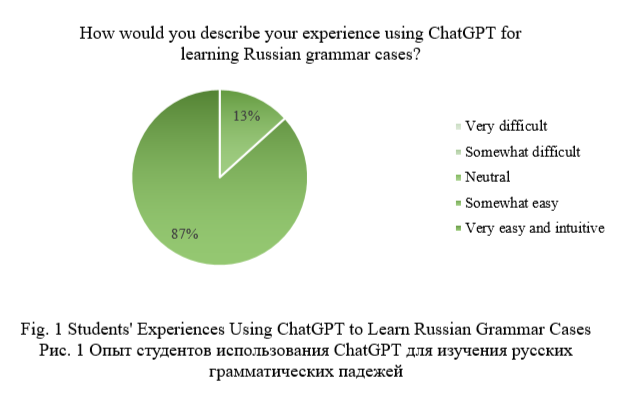
Regarding usability, a significant majority of students (87%) reported that they found ChatGPT to be exceedingly user-friendly, while 13% indicated that they perceived it as somewhat simple to use. The majority of participants expressed their appreciation for the round-the-clock accessibility, which enabled them to obtain immediate grammar explanations beyond regular class hours. It is evident that the utilization of ChatGPT is quite straightforward, as no student reported encountering any difficulties in its use. The easy use of ChatGPT is viewed and mirrored in the interview as one of the participants stated that “I can practice grammar or Russian cases at any time I want, it gives me the feedback right away if I make a mistake”. Another one said that “It’s like having a tutor, ChatGPT is 24/7”.
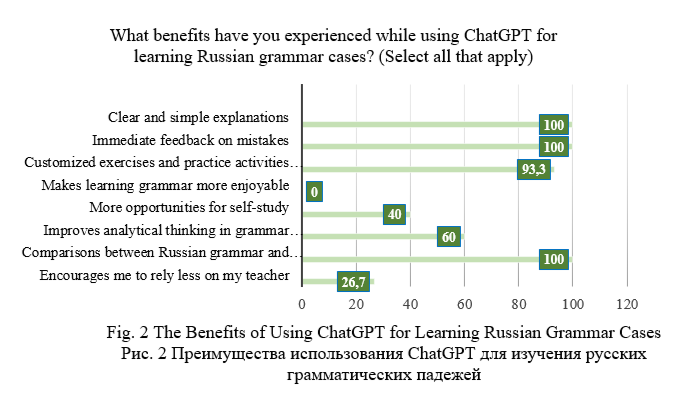
In regards to the benefits of ChatGPT for learning or studying Russian grammar cases as shown in Figure No. 2. It is clear in the chart that all the students (100%) agreed that ChatGPT helps them in explaining the Russian grammar cases in an easy and clear way, provide instant feedback on their mistakes as well as compare the Russian grammar cases to their native language grammar. One student stated that “When I do not understand a Russian case, I ask ChatGPT to help me compare it to English grammar, which makes it easier to understand”. Also, almost most of the participants agreed that ChatGPT helps them to practice a variety of different activities, tasks or customized exercises. The chart also shows that (60%) of the participants think that ChatGPT has the ability to improve their analytical thinking in regards to Russian grammar cases and just (40%) think that this tool gives them more opportunities for self-study. While only (26,7%) of the students believe that ChatGPT can make them rely on themselves more than on teachers. Lastly, none of the participants thought that ChatGPT could make the Russian grammar cases enjoyable.
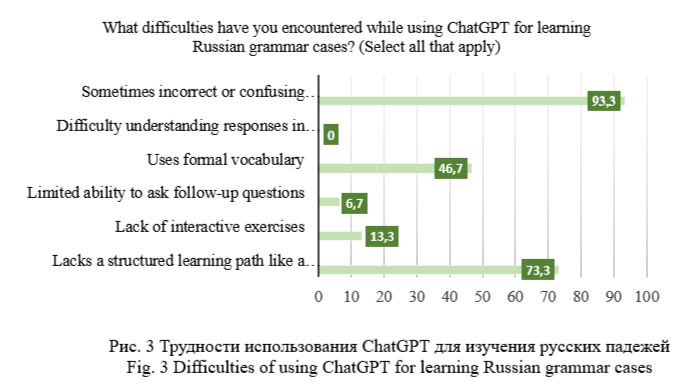
Despite these advantages, several challenges emerged as it is shown on graph No.3 that more than a third of students (93,3%) sometimes encountered inaccuracies or somehow confusing explanations in ChatGPT’s explanations or examples, requiring verification with teachers. As one of the students stated that “Once I did my homework with the help of ChatGPT but the teacher told me that was wrong”. Additionally, approximately three-quarters (73,3%) of the students reported that ChatGPT lacks a structured learning path similar to that of a traditional teacher. Almost half of the students (46,7%) think that ChatGPT uses formal and academic words that may not be commonly used in their daily conversations. Also, it is important to note that none of the participants reported that ChatGPT does not work or has difficulties with the Russian language.
To find out how well ChatGPT can help with learning Russian grammar, a question was asked to ChatGPT: “How does the dative case work in Russian? Please compare it to English grammar if possible?” The below figures 4-6 show different parts of its response. ChatGPT explained and gave a clear and structured explanation, breaking down the dative case into different functions like indirect objects, expressing necessity, age, feelings, and certain actions. It also compared Russian grammar to English, making it easier for students to understand. The use of examples and tables help organize the information in a way that is simple and accessible. As mentioned above, most of the students agreed that ChatGPT is useful for learning grammar because it explains things clearly and compares Russian to their native language. A lot of students agreed that ChatGPT helps them learn grammar because it makes things clear and lets them compare Russian to their own language. Plus, ChatGPT is not just for explanations but students can ask follow-up questions, ask for more examples, make quizzes, create different tasks, or ask for more clarification. This makes ChatGPT a flexible and interactive tool that adapts to students’ needs, helping them learn in a way that works best for them.
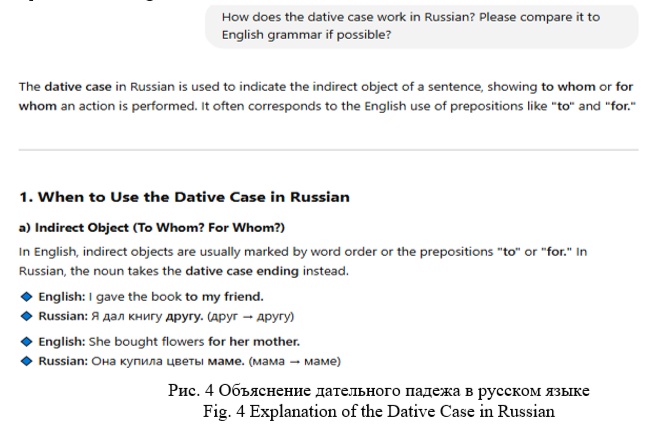
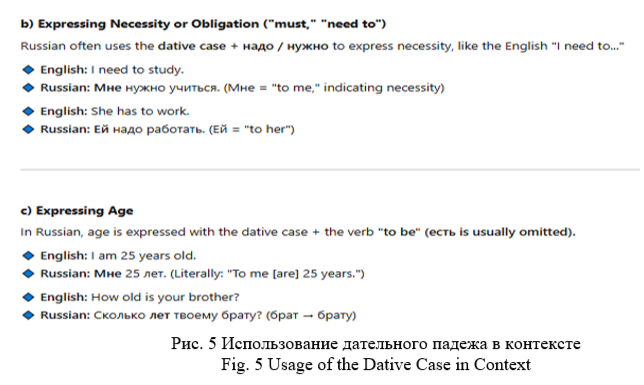
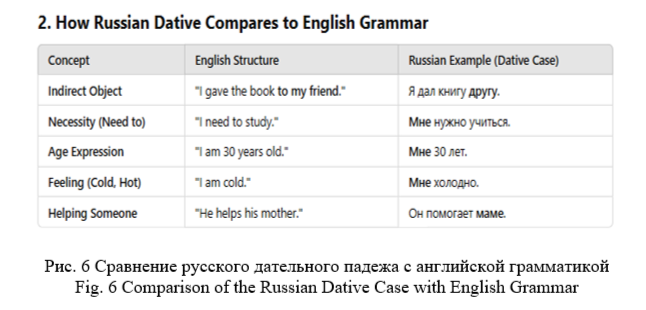
Overall, students viewed ChatGPT as a valuable supplement for learning Russian grammar cases, offering instant and clear explanations as well as customized exercises. However, concerns about accuracy, contextual understanding, and formal language suggest that AI should complement rather than replace traditional learning methods.
In this section, the findings of the study are explained in the light of previous research on using AI in language learning specifically in the acquisition of Russian grammar.
The results show that students have a generally positive perception of using ChatGPT as a supplementary tool for learning Russian grammar cases. The participants of the survey approved the functionality of the application, which provided them with instant feedback and individual explanations. These results are in line with Chiu et al. (Chiu, et al., 2023) and Su and Yang (Su, Yang, 2023) who stated that interactive chatbots students can get immediate feedback right after the mistakes and can provide a number of different activities customized for individual needs. One of the interviews responses and supports this idea “Whenever I make mistakes, I ask ChatGPT to correct me and to explain why this sentence is wrong, this helps me understand the grammar much better”. While ChatGPT offers one-click or fast feedback on mistakes, a few students thought teacher-led explanations sometimes were clearer. This is consistent with Hong (Hong, 2023), who underlined that although AI technologies like ChatGPT can offer instant feedback and interactive learning chances, their efficacy relies on how they are included into conventional teaching strategies.
One interesting thing was the grammar comparison capability of ChatGPT, which students found very useful and this aligns with the Pang S. et al. (Pang et al., 2024) who stated that ChatGPT has the ability to compare the grammar of different languages. One of the students commented, “I often ask ChatGPT to compare certain Russian cases or any Russian grammar to my native language which makes it easy for me to understand”. This implies that artificial intelligence tools can enable students to link newly introduced ideas with past language skills. One of the major issues or challenges found was the incorrect information provided by ChatGPT especially in the case of grammar cases and sentence structure. Such inaccuracies are in line with those found by Slamet J. (Slamet, 2024) who noted that at times AI tools can provide contextually inapposite responses. As a technology, AI can help in reducing anxiety and providing private practice but may produce errors that require validation by human experts. The lack of contextualisation in ChatGPT’s explanations reveals the need for human instructors in language learning. Finally, some students depended too much on the AI, and this led to shallow learning. This is supported by Kostka I., Toncelli R. (Kostka, Toncelli, 2023), who argued that ChatGPT may not enhance problem solving or critical thinking skills.
The study presents several implications for practice for educators, students, and AI designers. First, ChatGPT should be used in pairs or groups, and teachers should make sure that students check the information obtained from the AI tool in textbooks or with native speakers. This will prevent students from over relying on the technology and encourage them to think critically. Also, teachers should concentrate on task-based learning, where students develop dialogues or work on particular grammar structures and use ChatGPT for checking. For students, the findings of the study suggest that ChatGPT should be employed as a learning companion for practice and asking questions, but not as the only source of learning. They should be encouraged to compare the AI outputs with other sources and learn actively through generating their own language structures. Instead of expecting changes from AI developers, it is more practical for teachers to guide students in understanding that ChatGPT may sometimes give incomplete or inaccurate explanations. Teachers can help students learn how to double-check AI answers, notice possible mistakes, and use reliable materials to confirm grammar rules. In this way, students learn to work with AI tools more safely and become more confident in identifying correct Russian grammar on their own.
The results of this study also show how important the teacher’s role is when students use AI tools like ChatGPT. Before turning to ChatGPT, students really need to learn the basic rules of Russian cases from their teacher so they already know what to expect and how the forms work. After that, they can use ChatGPT to practice, but only if they keep checking and thinking carefully about the answers they receive. If students use the tool without any guidance or without questioning the explanations, they can easily misunderstand something or learn an incorrect form, which some participants in this study experienced. This makes it clear that AI can be helpful, but only when students use it carefully and always double-check things with their teacher or other reliable sources.
Another important point that came out of this study is how AI mistakes and “hallucinations” can affect English-speaking students who are learning Russian cases. Because Russian has a very different structure from English, even small errors in an AI-generated explanation can easily lead students to form the wrong rule or memorize an incorrect ending. Several participants mentioned moments where an answer looked correct at first glance but later turned out to be inaccurate. Understanding these risks can actually help improve students’ literacy: when teachers encourage students to question unexpected answers and compare them with reliable sources, students become more aware of how Russian cases really work. In this way, the presence of AI mistakes becomes a learning opportunity that strengthens students’ attention to form and accuracy.
It is also worth mentioning that there are Russian-language AI tools, such as GigaChat, which some students might use when learning Russian grammar. As GigaChat is specifically designed for the Russian language, it can provide clearer examples and more accurate case endings, particularly in everyday sentences, than ChatGPT. A short comparison suggests that both tools can be helpful, but neither should be used as a fully reliable source on its own. For students, this means that having access to a Russian-language AI can be useful, but they still need guidance from their teacher and traditional materials to understand Russian cases correctly.
Conclusions. This research has given a better understanding of how students use ChatGPT as a learning tool for Russian grammar cases and what challenges they encounter. The results show that although ChatGPT is considered convenient and helpful for drilling grammar concepts, it is not always perfect. The students liked the instant feedback, the individual activities and the examples but some of them were concerned about the correctness of the information provided by ChatGPT. It shows that while ChatGPT can be a good assistance and a useful tool in the process of RFL, yet it is not enough to replace the traditional way of teaching. The tool can be more useful when used together with explanations from teachers and textbooks. These findings indicate that although AI tools such as ChatGPT have a number of advantages in the process of language learning, their effectiveness can depend on how they are applied. Teachers should assist students in using AI-supported materials as additional learning resources and encourage them to think critically about the information provided by AI. Since the study was conducted with a small sample of fifteen participants, the findings may not be fully generalizable. In the future, further investigations should continue to investigate the impact of ChatGPT on grammar learning over time and compare it with other AI tools. It would also be useful to increase the sample size to include students from various language backgrounds to determine how they apply and benefit from AI-assisted learning. Thus, knowing how to incorporate AI into the learning process with humans will enable educators to develop innovative learning environments that can help students learn independently and critically analyse various grammar rules. At the same time, the study shows that AI can sometimes give misleading or incorrect answers, so students really need guidance in double-checking ChatGPT’s explanations to avoid picking up wrong grammar patterns.















Список литературы
Abdalgane, M. and Othman, K.A. (2023), “Utilizing artificial intelligence technologies in Saudi EFL tertiary level classrooms”, Journal of Intercultural Communication, 23(1), 92-99. DOI: 10.36923/jicc.v23i1.124. (In UK).
Alhusaiyan, E. (2025), “A systematic review of current trends in artificial intelligence in foreign language learning”, Saudi Journal of Language Studies, 5 (1), 1-16. https://doi.org/10.1108/SJLS-07-2024-0039. (In Saudi Arabia).
Ali, J.K.M., Shamsan, M.A.A., Hezam, T.A. and Mohammed, A.A. (2023), “Impact of ChatGPT on learning motivation: Teachers and students' voices”, Journal of English Studies in Arabia Felix, 2(1), 41-49. https://doi.org/10.56540/jesaf.v2i1.51. (In Yemen).
Alzahrani, I.H. (2024), “Exploring Learners’ beliefs on grammar Learning: importance and preferred methods”, Theory and Practice in Language Studies, 14(5), 1475-1485. https://doi.org/10.17507/tpls.1405.20. (In UK).
Baidoo-Anu, D. and OwusuAnsah, L. (2023), “Education in the era of generative artificial intelligence (AI): Understanding the potential benefits of ChatGPT in promoting teaching and learning”, Journal of AI, 7(1), 52-62. https://doi.org/10.61969/jai.1337500. (In Turkey).
Bekou, A., Ben Mhamed, M. and Assissou, K. (2024), “Exploring opportunities and challenges of using ChatGPT in English language teaching (ELT) in Morocco”, Focus on ELT Journal, 6(1), 87-106. https://doi.org/10.14744/felt.6.1.7. (In Morocco).
Bonner, E., Lege, R. and Frazier, E. (2023), “Large language model-based artificial intelligence in the language classroom: practical ideas for teaching”, Teaching English with Technology, 23(1), 23-41. https://doi.org/10.56297/BKAM1691/WIEO1749. (In Cyprus).
Ceytlin, S.N. and Kruglyakova, T.A. (2024), “Case system in learning Russian as a first and second foreign language”, Russian Language Studies, 22(1), 135-149. http://doi.org/10.22363/2618-8163-2024-22-1-135-149. (In Russia).
Chan, C.K.U. and Hu, W, (2023), “Students’ voices on generative AI: perceptions, benefits, and challenges in higher education”, Int J Educ Technol High Educ, 20(43), 1-18. https://doi.org/10.1186/s41239-023-00411-8. (In Germany).
Chen, H., Yuan, K., Huang, Y., Guo, L., Wang, Y. and Chen, J. (2023), “Feedback is all you need: from ChatGPT to autonomous driving”, Science China Inf Sci. 66(6), 166201. https://doi.org/10.1007/s11432-023-3740-x. (In Germany).
Chiu, T.K.F., Moorhouse, B.L., Chai, C.S. and Ismailov, M. (2023), “Teacher support and student motivation to learn with artificial intelligence (AI) based chatbot”, Interact Learn Environments, 32(7), 3240-3256. https://doi.org/10.1080/10494820.2023.2172044. (In UK).
Çobanoğullari, F. and Özbek, Ö. (2025), “AI-powered language learning: Developing the ChatGPT usage scale for foreign language learners”, Educ. Inf. Technol. https://doi.org/10.1007/s10639-025-13342-w. (In Germany).
Farhi, F., Jeljeli, R., Aburezeq, I., Dweikat, F.F., Al-shami, S.A. and Slamene, R. (2023), “Analyzing the students' views, concerns, and perceived ethics about ChatGPT usage”, Computers and Education: Artificial Intelligence, 5, 1-8. https://doi.org/10.1016/j.caeai.2023.100180. (In Netherlands).
Fuchs, K. (2023), “Exploring the opportunities and challenges of NLP models in higher education: is Chat GPT a blessing or a curse?”, Front. Educ. 8, 1-4. DOI: 10.3389/feduc.2023.1166682. (In Switzerland).
Hong, W.C.H. (2023), “The impact of ChatGPT on foreign language teaching and learning: Opportunities in education and research”, Journal of Educational Technology and Innovation, 5(1), 37-45. DOI: https://doi.org/10.61414/jeti.v5i1.103. (In Australia).
Kohnke, L., Moorhouse, B. L. and Zou, D. (2023), “ChatGPT for language teaching and learning”, RELC Journal, 54(2), 1-14. https://doi.org/10.1177/0033688223116286. (In UK).
Kostka, I. and Toncelli, R. (2023), “Exploring applications of ChatGPT to English language teaching: Opportunities, challenges, and recommendations”, The Electronic Journal for English as a Second Language (TESL-EJ), 27(3), 1-19. https://doi.org/10.55593/ej.27107int. (In USA).
Kucuk, T. (2024), “ChatGPT Integrated Grammar Teaching and Learning in EFL Classes: A Study on Tishk International University Students in Erbil, Iraq”, Arab World English Journal, 1(1), 100-111. https://doi.org/10.24093/awej/ChatGPT.6. (In Malaysia).
Pang, S., Nol, E. and Heng, K. (2024), “ChatGPT-4o for English language teaching and learning: Features, applications, and future prospects”, Cambodian Journal of Educational Research, 4(1), 35-56. https://doi.org/10.62037/cjer.2024.04.01.03. (In Cambodia).
Pokrivcakova, S. (2019), “Preparing teachers for the application of AI-powered technologies in foreign language education”, Journal of Language and Cultural Education, 7(3), 135-153. https://doi.org/10.2478/jolace-2019-0025. (In Slovakia).
Roe, J. and Perkins, M. (2023), “What they”re not telling you about ChatGPT’: Exploring the discourse of AI in UK news media headlines”, Humanities & Social Sciences Communications, 10(1). https://doi.org/10.1057/s41599-023-02282-w. (In UK).
Roumeliotis, K.I. and Tselikas, N.D. (2023), “ChatGPT and open-AI models: A preliminary review”, Future Internet, 15(6), 192. https://doi.org/10.3390/fi15060192. (In Switzerland).
Singh, O. (2023), “Artificial intelligence in the era of ChatGPT: Opportunities and challenges in mental health care”, Indian Journal of Psychiatry, 65(3), 297-298. https://doi.org/10.4103/Indianpsychiatry.indianjpsychiatry_112_23. (In India).
Slamet, J. (2024), “Potential of ChatGPT as a digital language learning assistant: EFL teachers’ and students’ perceptions”, Discov Artif Intell, 4(46) https://doi.org/10.1007/s44163-024-00143-2. (In Germany).
Su, J. and Yang, W. (2023), “Unlocking the power of ChatGPT: a framework for applying generative AI in education”, ECNU Rev Educ, 6(3), https://doi.org/10.1177/20965311231168423. (In UK).
Xu, Y. and Shuang, Z. (2019), “A study of language transfer between Chinese and English to Russian as a second foreign language”, International Conference on Arts, Management, Education and Innovation (ICAMEI 2019), 246-250. DOI:10.23977/icamei.2019.046. (In Canada).
Yaping, W., Yasmin, H.Z., Jimei, L. and Ying, P. (2024), “Opportunities and Challenges of Using ChatGPT as a Teaching Assistant in English Language Teaching: A Systematic Literature Review”, In Proceedings of the 2024 International Symposium on Artificial Intelligence for Education (ISAIE '24), 375-382. https://doi.org/10.1145/3700297.3700362. (In USA).